
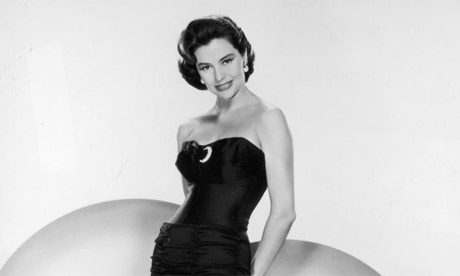
Cyd Charisse was not the greatest of movie stars. When she sang, she was dubbed. When she spoke, she was on cue, at best. But when she danced, there was no need for artifice. A couple of dozen times in the 1950s, she moved across a screen to music and brought us all close to heaven. That's why everyone knew her odd name, Cyd Charisse. It's a name that, when put together with that of her oftentimes partner – 'Cyd Charisse and Fred Astaire' – makes a phrase with the natural rhythm of poetry.
Charisse was not our last link with the Metro-Goldwyn-Mayer musicals: Debbie Reynolds is alive and kicking, as are Andre Previn, Lena Horne and Mickey Rooney. Long may they last. And there are still a few movie stars who made their names in the Thirties who are active and alert – those remarkable sisters, Olivia de Havilland and Joan Fontaine, and … well, I can't bring another name to mind quickly. The last authentic star, major league, still alive? Doris Day?
So a generation of actors, players or performers is passing. Hasn't it always been the case? Garrick died, so did Kean, Rachel and Bernhardt, and no doubt the poets and the press agents asked, "When comes such another?" as they were already grooming the replacements.
But very few people saw Garrick or Kean, and everyone knew Chaplin, Cooper, Gable, Cagney, Grant, Wayne and so on, down to someone like Richard Widmark who died just a few weeks ago, and who represented a look, a voice, a giggle, a snarl and the ethos behind different responses to life. They were archetypes, Chaplinesque or Widmarkesque. They were people or qualities in our dreams.
It seemed for a while that one generation of stars would give way to another. After all, weren't William Holden, Grace Kelly, Burt Lancaster, Marilyn Monroe – all stars, stars of the Fifties? For a while, yes, but since then we have realized that stars now are not what stars were. They don't want to be. We don't need them to be. And the system and our tastes have become so much more cynical and fickle. From the Twenties to the Thirties, the look and sound of a few people went around the world for the first time. It was called stardom, and it required the novelty of the experience and the relative innocence of the believers.
The movies do not matter, or grip us, as once they did. There's no point in regretting this or asking for the past to come back. The past is still here – you can go round the corner tonight and rent a couple of hours of Bette Davis, or Garbo or Katharine Hepburn. And you can still feel the uncanny authority they had – though it drove some of them crazy – that cinematography had found a way of dealing in the aura of gods and goddesses. But stardom soured us, too. It taught us that we were idolising worthless, troubled shells. There was a stretch of forty years when girls from Texas became world-famous and spectators came to know strangers. Then we gave up on the cult. But it would be sad if our culture ever forgot how much once we liked these bright strangers and found hope in them.
