
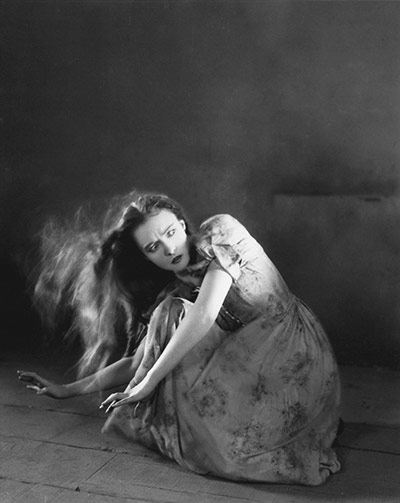
Lillian Gish, one of the most celebrated actors of the silent era, stars in The Wind, by Swedish director Victor Sjöström. Gish plays Letty, a young woman plagued by the elements and some spectacularly brutish men in a remote ranch. The film was shot on location on the Mojave Desert with wind machines providing the dramatic storms, but this interior-shot still by Milton Brown, together with Gish's pained pose, captures Letty's claustrophobic, psychological terror rather than its physical manifestation Photograph: University of Chicago Press
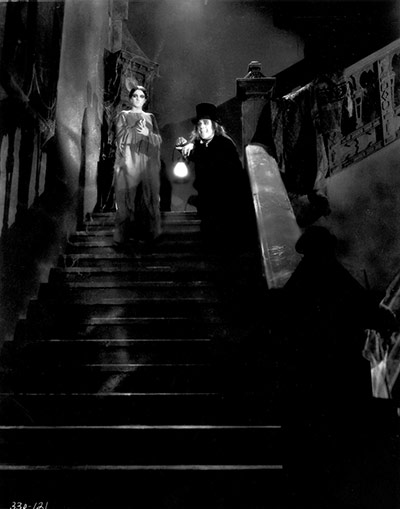
The holy grail for many a silent film collector, Tod Browning's London After Midnight is a lost film – the last remaining copy is thought to have been burned in a fire at the MGM vault in 1967. Stills such as this one, by Bert Longworth, reveal why it is so highly sought after. Lon Chaney and Edna Tichenor play the ghoulish and mysterious strangers who appear in a dead man's house five years after his apparent suicide. It is characteristic of Longworth's stills work that the figures, while central to the composition, are dominated by the architecture – also that the camera is positioned at a low angle and the shadows are distorted. Longworth was fascinated by the expressionist films made in Germany, and it shows Photograph: University of Chicago Press
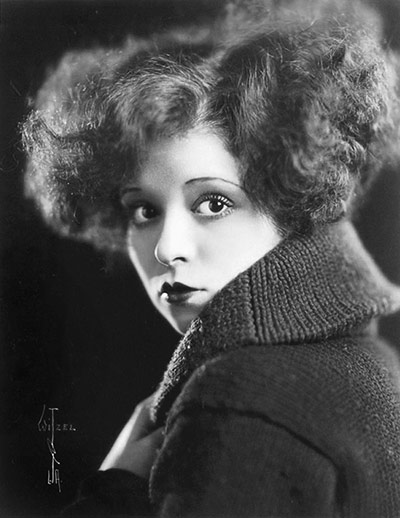
This portrait of Clara Bow by Max Munn Autrey is as chilling as it is glamorous – capturing the star's beauty but also an unnervingly blank expression. Bow's fashionable heavy makeup and outrageously bouncy bobbed hair are highlighted by soft 'beauty' lighting, but undermined by that jumper. This photograph was taken in 1923, the year that Bow left her impoverished home in a tenement in Prospect Heights, New York, to move to Hollywood. She would become one of the silent era's biggest stars, but this image catches her in transition between Brooklyn and LA Photograph: University of Chicago Press
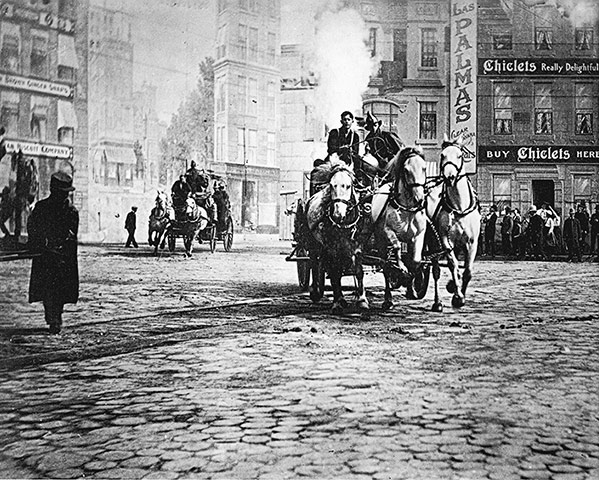
The Dreamland amusement park in Coney Island opened in 1904, and was razed in a massive fire in 1911. Strange, then, that its biggest attraction in the early days was Fighting the Flames, a spectacle in which firefighters paraded on their horse-drawn engines before extinguishing a simulated fire at a multi-storey hotel, and rescuing the distraught 'guests'. This is a specially taken promotional image for Fighting the Flames, Dreamland, an actuality film photographed in the park's first year of business by one Billy Bitzer for the Biograph company in New York. Both Bitzer and Biograph are best known now for their associations with the director DW Griffith; Bitzer was his favoured cinematographer, Biograph the studio where he made his first films, beginning with The Adventures of Dollie in 1908 Photograph: University of Chicago Press
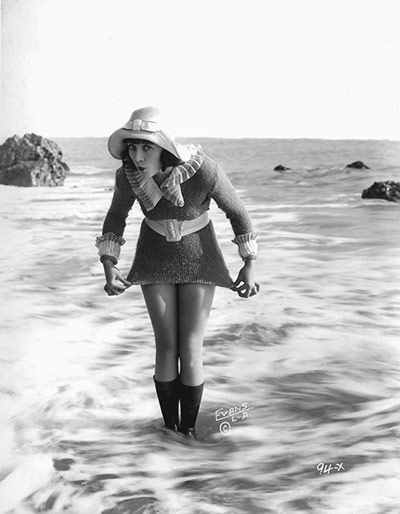
A fine, perhaps underrated, comic actor, Marie Prevost is pictured here by Nelson Evans in her early days as one of Mack Sennett's Bathing Beauties. Evans is credited with inventing the classic Hollywood 'cheescake' style, thanks to flirty shots such as this one. He was also renowned for retouching his frames, often engraving his glass negative plates. The surf around Prevost's ankles here may well have been manipulated. Sadly, Prevost's career began to decline in the late 1920s and a combination of binge eating and alcoholism would go on to destroy her looks and mental health. The booze eventually killed her in 1937 Photograph: University of Chicago Press
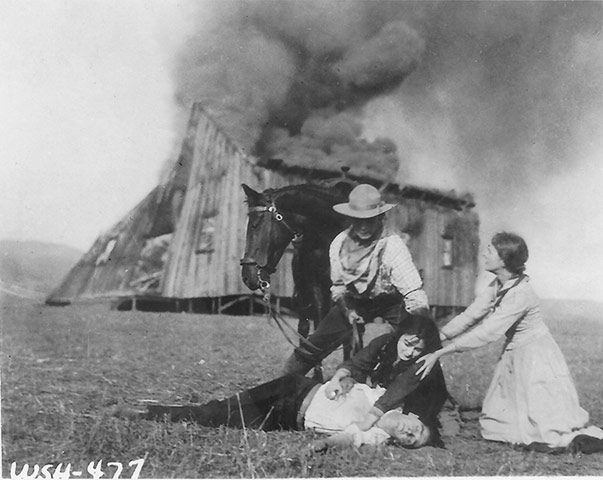
In this early western, William S Hart essayed his hard-bitten hero act as Blaze Tracy, a loner who rides into Hell's Hinges, 'a gun-fighting, man-killing, devil's den of iniquity'. Tracy forms an unlikely alliance with the pastor and his young sister, rather than the ne'er-do-well townsfolk, and ultimately destroys Hell's Hinges in an act of righteous vengeance. This image is by Hart's favourite stills artist Junius 'June' Estep, a former portrait photographer from LA. It depicts Tracy discovering the pastor dead while, in the background, the church goes up in smoke Photograph: University of Chicago Press
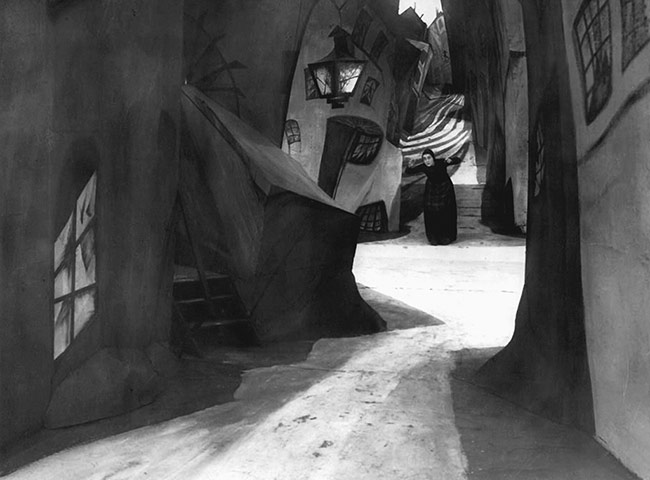
Lil Dagover cowers on possibly the most recognisable set in film history – the nightmare landscape of Robert Wiene's The Cabinet of Dr Caligari. Hermann Warm's boldly expressionist designs for the film, with their tipsy angles and long shadows, encapsulate its twisting plot and air of paranoia. Cinematographer Willy Hameister's camera tilts downwards, an unsettling angle that further exaggerates the effect Photograph: University of Chicago Press
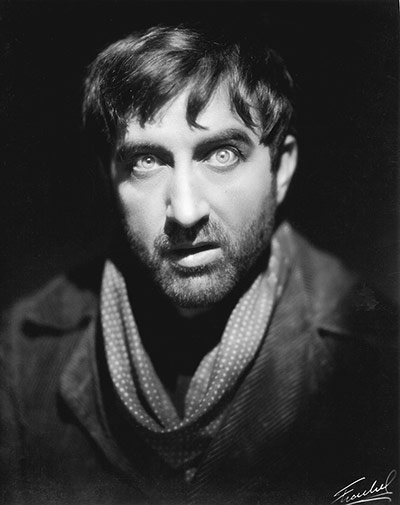
Bodybuilder turned actor Francis X Bushman (the X stands for Xavier) was dubbed "The Handsomest Man in the World" by studio publicity and made nearly 200 films, mostly in the 1910s, very few of which survive today. He is most familiar now for his performance as Messala in the 1925 Ben Hur. This striking still from lost film The Grip of the Yukon was taken by Jack Freulich. It's typical of Freulich's film star portraits in that it emphasises character over physical perfection – here the man they nicknamed Francis "Sex" Bushman is a haunted soul rather than a hunk Photograph: University of Chicago Press
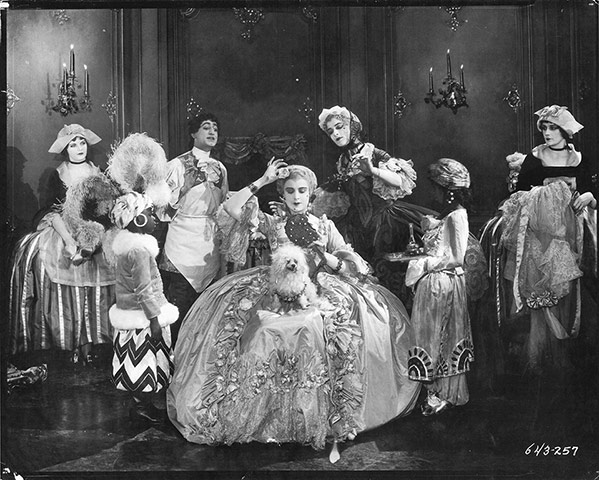
Lois Wilson is the Queen of France, circled by attendants and accompanied by her lapdog in this typically lavish still from Paramount's Monsieur Beaucaire. Not pictured here is the film's star Rudolph Valentino, whose wife Natacha Rambova designed those fabulous costumes (at a cost of $215,000) as well as the sets. The film failed to recoup its generous budget at the box office and inevitably Rambova was criticised for her expensive interventions. Nevertheless, it's a gorgeous-looking film with first-rate cinematography by Harry Fischbeck. This publicity still by Russell Ball showcases Rambova's art direction and Fischbeck's lighting with an elegant and witty composition Photograph: University of Chicago Press
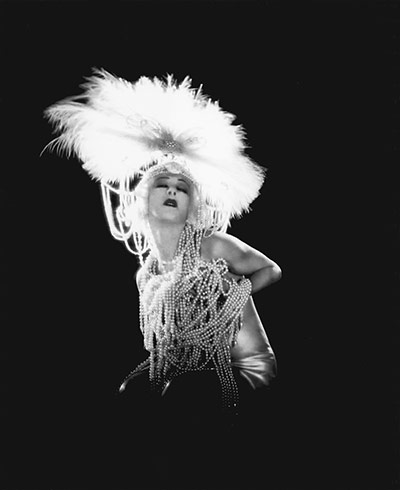
Alla Nazimova, often known simply by her last name, was a writer, producer and actor and one of the most fascinating figures in silent film history. Salomé, an adaptation of the Oscar Wilde play, has become a cult classic, noted for Nazimova's dance of the seven veils and Natacha Rambova's Aubrey Beardsley-inspired designs. Crimea-born Nazimova was a lesbian, and while the rumour swirls that she and Natacha Rambova were lovers, it has never been confirmed. Far more outlandish, and even less likely to be true, is the story that Salomé was produced by an all-gay cast and crew. This eerie, sexy still by Arthur F Rice, the photographer that Shields labels a 'genius', captures the film, and its star, in all their decadent glory. 'In Rice's stills,' writes Shields, 'we see the subtlety of lighting and visual arrangement and read the dynamic of emotional conflict without caption.' Photograph: University of Chicago Press
